

Montreal (QC, Canada) Sept 14th 2026 — Researchers from McGill University, including the founders of Telescope Therapeutics have conducted a comprehensive evaluation of human induced pluripotent stem cell-derived cardiomyocytes (hiPSC-CMs) generated from patients with non-ischemic or dilated cardiomyopathy (DCM), providing new insights into the cellular mechanisms associated with this serious form of heart failure disease.
DCM accounts for roughly 30-40% of all heart failure cases and is characterised by an abnormal enlargement of the left ventricle, compromising the ability of the heart to pump blood to the body. Patients with DCM are offered the same type of treatment regimens regardless of individual differences, some patients may fully recover cardiac function while others continue to deteriorate, requiring heart replacement therapy or palliation.
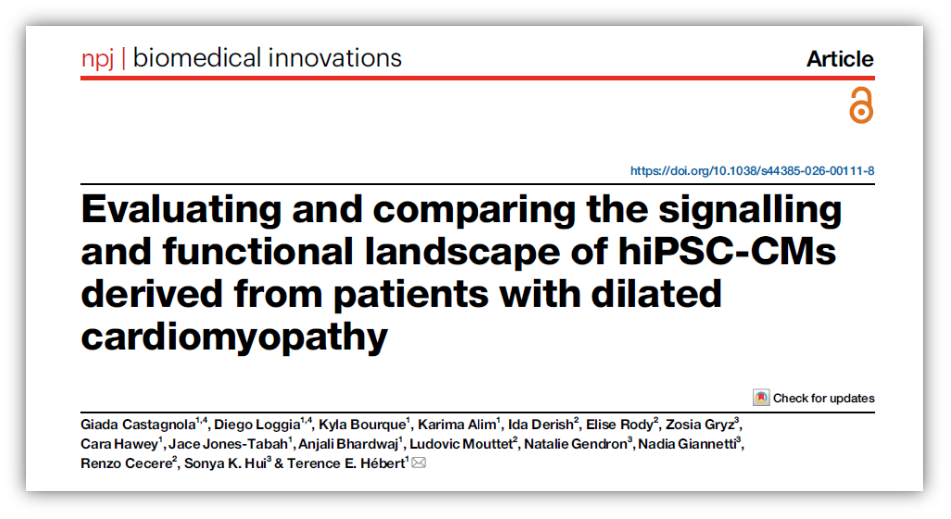
The translational study by Giada Castagnola, Diego Loggia and colleagues, titled Evaluating and comparing the signalling and functional landscape of hiPSC-CMs derived from patients with dilated cardiomyopathy, published today in NJP Biomedical Innovations, uncovered that patient-specific molecular mechanisms in DCM.Suggesting that we might eventually be able to take a patient's own cells to test how their heart respond to different drugs to identify the signalling problem and personalize the treatment options accordingly.
Despite advances in understanding the disease, the cellular mechanisms underlying DCM remain complex and can vary considerably between patients. By using hiPSC-derived cardiomyocytes as a patient-specific model, the researchers were able to investigate disease-associated changes at the cellular level. The findings provide a more detailed picture of how signalling processes and cardiac function may be altered in DCM and highlight potential pathways for further investigation.
“This work, which originated in our academic collaboration as founders, drove one of the axes on which TelescopeTherapeutics is based- the ability to perform state of the art, biosensor-based drug discovery in iPSC-derived disease models”. said Prof.Terence Hébert PhD, CSO at Telescope Therapeutics.
The study demonstrates the potential of patient-derived cardiac models to help bridge the gap between genetic or molecular changes and their functional consequences in heart muscle cells. This may suggest that we might eventually be able to take a patient's own cells to test how their heart respond to different drugs to identify the signalling problem and personalize the treatment options accordingly. However, further studies will be needed.
About Telescope Therapeutics
Telescope Therapeutics is advancing a targeted pipeline to halt and reverse fibrotic diseases. Powered by its unique disease modeling platform, Telescope combines induced pluripotent stem cell-based models with advanced biosensors capturing human-relevant disease biology early in drug discovery. With this predictive platform, Telescope's goal is to bring effective therapeutic solutions to patients affected by fibrotic diseases.
For more information, visit www.telescopetherapeutics.com
Media Contacts: Myriam Lavoie, MS, Telescope Therapeutics(CEO) myriam.l@telescopetherapeutics.com
